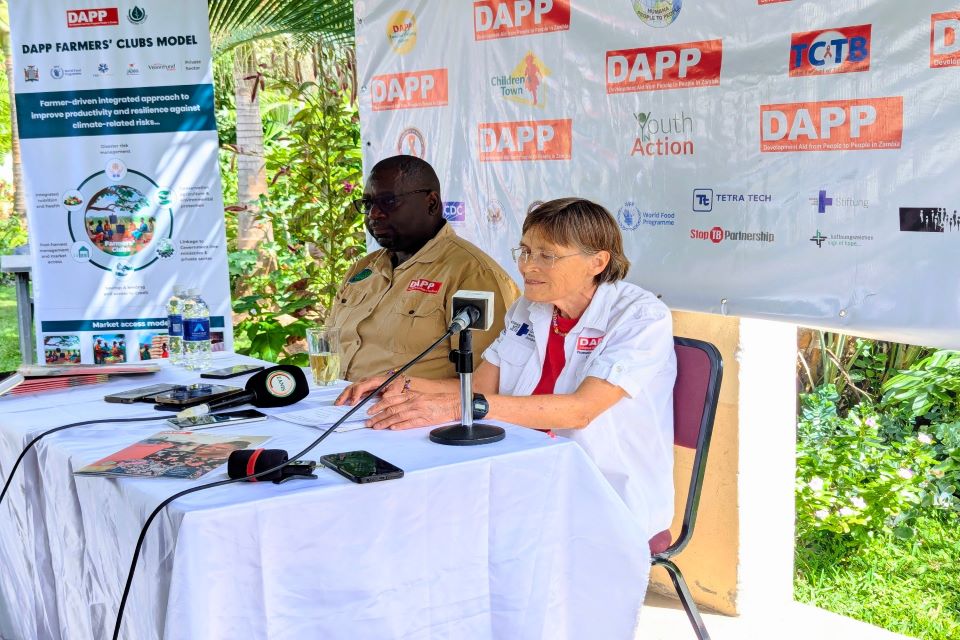
 Development Aid from People to People (DAPP) Zambia yesterday launched the 2025 DAPP Zambia Progress Report at the Partnership Office in Lusaka, revealing that the organisation reached more than 1.5 million people across all ten provinces in 2025. The results highlight the strength of community-driven development despite economic pressures, climate shocks, and reduced donor funding.
Speaking during the launch, Managing Director Elise Soerensen said the organisation’s impact was built on one key principle: communities must lead their own development.
“People are not beneficiaries—they are drivers of their own development. When communities are trusted, organised, and given the right support, they are able to solve challenges, create opportunities, and improve their own lives. Even in a year marked by reduced donor funding, climate shocks, and global uncertainty, communities continued to move forward with strength and determination,” she said.
In agriculture, DAPP Zambia worked with more than 63,000 farmers, organised in over 1,100 farmers’ clubs, with training in climate-smart agriculture and improved market access. Through collective production and marketing, farmers sold crops worth over K15.9 million, showing that smallholder farming can become a profitable business.
“This is clear evidence that agriculture can be a viable business for smallholder farmers. When farmers work together, access knowledge, and connect to markets, they increase incomes and strengthen food security for their families,” Elise said.
Communities also strengthened environmental action by planting nearly 15,000 trees, promoting energy-saving stoves, and adopting sustainable land practices.
In the health sector, DAPP Zambia reached over 400,000 people with HIV prevention, care, and treatment services. The organisation recorded a 99.9 percent linkage to treatment for individuals diagnosed with HIV, reflecting strong community trust and follow-up systems.
Soerensen highlighted the success of the TRIO model, which uses family and peer support to improve treatment adherence and reduce stigma.
“Healing does not only happen in clinics—it happens within communities. When families and peers stand together, people are more likely to stay on treatment, overcome stigma, and live healthier lives,” she explained.
DAPP Zambia also expanded programmes in tuberculosis, malaria prevention, child immunisation, youth empowerment, and livelihoods support for vulnerable communities.
The 2025 results show that even during difficult times, communities can create lasting change when given the opportunity, knowledge, and support to lead their own progress.